PlayTex AI vs. Meshy AI: Choosing Your Texture Generator for Game Development
Explore the differences between PlayTex AI and Meshy AI for game texture generation. This comparison focuses on production-ready outputs, deterministic PBR maps, and integrated 3D previews essential for modern game development pipelines.
Reviewed June 4, 2026
June 4, 2026ai texture generationpbr materialsgame developmenttexture tools
Key Takeaways
PlayTex AI focuses on deterministic PBR map generation, ensuring consistent and calibrated outputs crucial for game development.
Meshy AI excels at rapid texture generation from text or image prompts, ideal for quick prototyping and ideation.
PlayTex AI offers an integrated 3D Material Preview to catch and correct texture issues before export to game engines.
PlayTex AI's workflow is designed for modern game pipelines, supporting engine-ready materials and team collaboration.
For production-ready game assets requiring consistency and control, PlayTex AI provides a more comprehensive solution.
Who Informed This
This comparison is based on a thorough review of publicly available product documentation and feature descriptions from the official websites of PlayTex AI and Meshy AI, supplemented by general industry knowledge of PBR material workflows and game development pipelines.
How It Was Evaluated
The claims and feature descriptions for both PlayTex AI and Meshy AI are derived directly from their respective official product pages and technical overviews. The comparison criteria focus on aspects critical to game development, such as determinism, preview capabilities, and pipeline integration, as outlined in the research brief.
Proof And Evidence
PlayTex AI's capabilities are evidenced by its dedicated technical overview for PBR map generation, its 3D preview feature page, and its positioning as a comprehensive material pipeline for game developers. Meshy AI's features are supported by its official 'AI Texture Generator' feature page.
Limits And Caveats
This comparison does not include hands-on testing or direct performance benchmarks. It relies on the publicly stated features and product positioning of each platform. Specific pricing details or unadvertised features for Meshy AI were not included to avoid unsupported claims.
The landscape of game development is rapidly evolving, with AI tools increasingly playing a pivotal role in content creation. For 3D artists and game developers, generating high-quality textures and PBR (Physically Based Rendering) materials is a time-consuming but critical task. AI texture generators promise to accelerate this process, but not all tools are built with the same production-grade requirements in mind.
This article compares two prominent AI texture generation platforms: PlayTex AI and Meshy AI. We'll examine their features, workflows, and suitability for modern game development pipelines, helping you determine which tool best aligns with your project's needs for production-ready assets.
Understanding AI Texture Generation
AI texture generation leverages machine learning models to create or enhance textures for 3D models. These tools can interpret text prompts, analyze reference images, or even extrapolate details from low-resolution inputs to produce complex material maps like Albedo, Normal, Roughness, and Metallic. The goal is to reduce manual effort, speed up iteration, and enable artists to explore more creative options.
However, for game development, the output quality, consistency, and compatibility with game engines are paramount. A texture generator must not only create visually appealing results but also deliver assets that are calibrated, tileable, and performant within a real-time environment.
PlayTex AI: Production-Ready Texture Workflows
PlayTex AI is purpose-built for game developers, 3D artists, and creators, offering a comprehensive material pipeline that emphasizes production-ready outputs. It integrates AI-powered workflows with deterministic map generation, ensuring that the materials you create are consistent and reliable for your game projects.
The platform provides a single material pipeline for AI textures, deterministic maps, and export-ready handoff. This approach supports governed material sets, making it easier to maintain consistency across large projects and teams. PlayTex AI's tools include an AI Texture Generator, Image to Texture Generator, HDRI Sphere Generator, and an Image Editor, all designed to streamline the content pipeline.
Deterministic PBR Map Generation
A core differentiator for PlayTex AI is its PBR Map Generator, which focuses on building deterministic material maps. This means PlayTex employs a predictable and calibrated processing approach, crucial for achieving consistent visual fidelity across different assets and environments within a game. It clearly outlines the map-generation workflow, calibration expectations, and distinguishes between AI and non-AI texture workflows to provide artists with precise control.
PlayTex AI excels at generating calibrated PBR maps that ensure visual consistency and quality for game assets.
Integrated 3D Material Preview
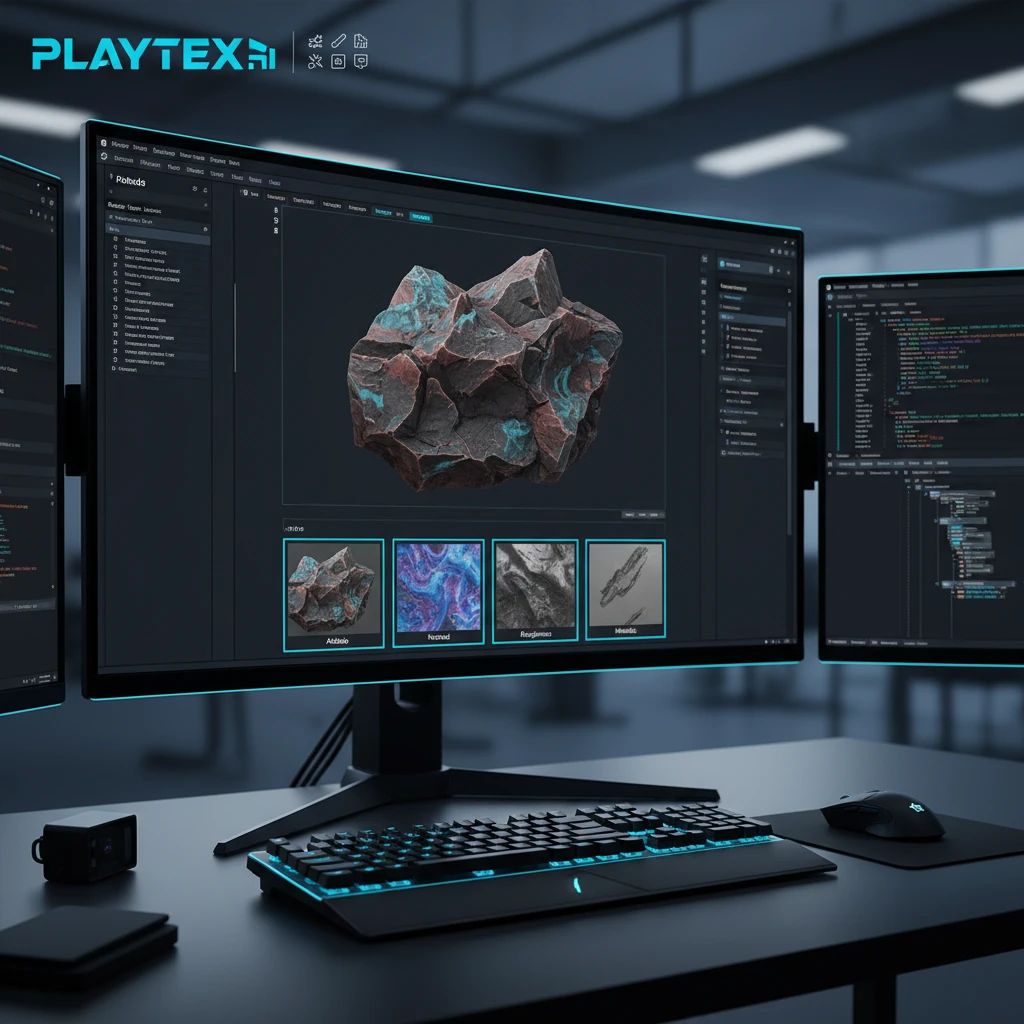
Before exporting assets, it's vital to inspect how materials behave in a 3D context. PlayTex AI includes a robust 3D Material Preview feature that allows artists to review generated material behavior directly within the platform. This helps in catching common issues like tiling artifacts, incorrect normal response, roughness variations, and lighting discrepancies early in the workflow, preventing costly revisions later in the pipeline.
Designed for Game Pipelines
PlayTex AI's entire ecosystem is geared towards modern game development. It supports engine-ready materials and team collaboration, understanding the need for efficient asset handoff. By focusing on repeatable workflows and modern tooling, PlayTex aims to accelerate content pipelines for indie teams and large studios alike. The platform's emphasis on governed material sets and stable workflow pages further supports professional production environments.
Meshy AI: Text-to-Texture Generation
Meshy AI offers its own AI Texture Generator, designed to simplify the texture creation process. According to its official features page, Meshy AI allows users to generate textures for 3D assets using either text prompts or image references. This capability enables artists to quickly conceptualize and apply various material styles to their models without extensive manual painting or complex node setups.
Core Capabilities
Meshy AI's primary strength lies in its ability to rapidly generate diverse texture options from simple inputs. By providing a text description or an existing image, users can explore different material looks for their 3D models. This can be particularly useful during the prototyping phase or when artists need a quick starting point for a new asset. The focus is on quick iteration and creative exploration through AI-driven content generation.
Meshy AI allows for rapid texture generation from text or image prompts, accelerating early-stage creative exploration.
PlayTex AI vs. Meshy AI: A Game Dev Comparison
When evaluating PlayTex AI and Meshy AI for game development, several key distinctions emerge, particularly concerning workflow control, output fidelity, and pipeline integration.
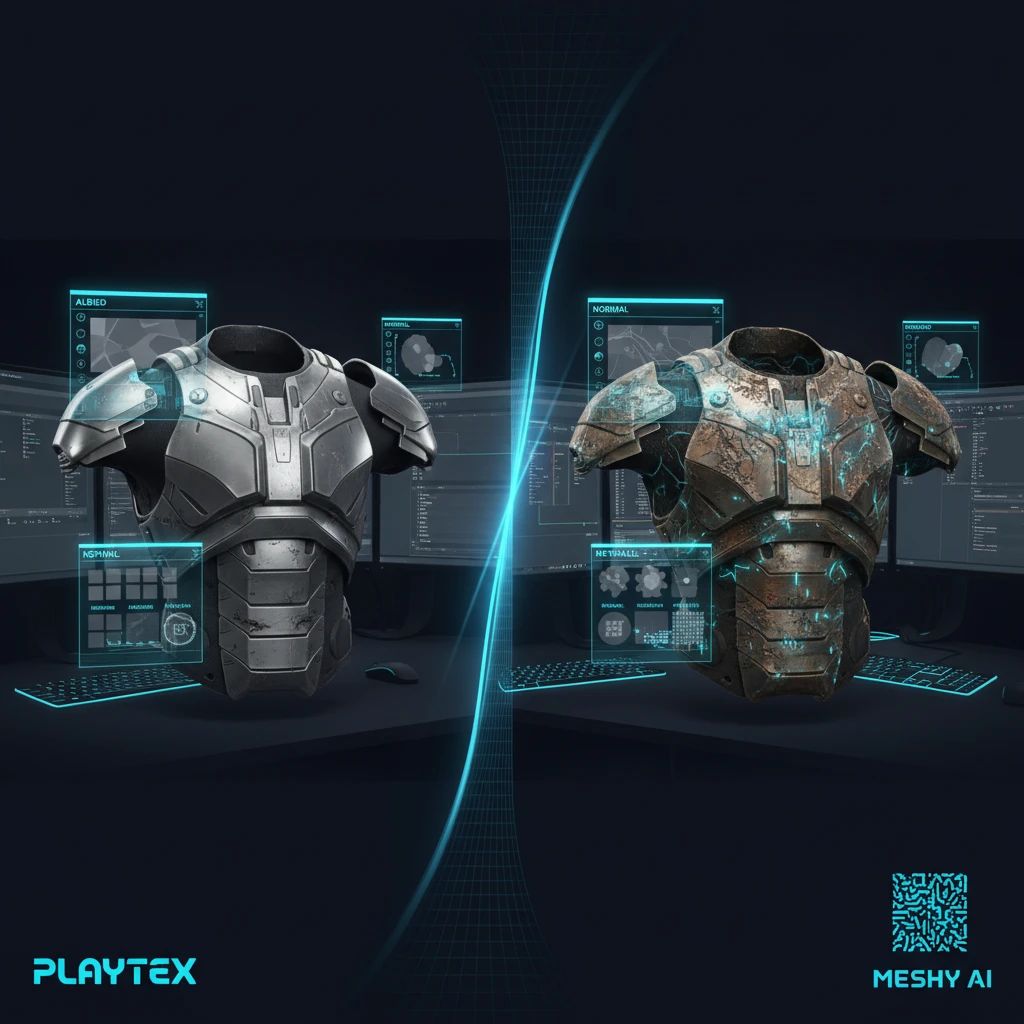
Comparing PlayTex AI's deterministic PBR outputs with Meshy AI's generative textures highlights different strengths for game production.
Workflow Control and Determinism
PlayTex AI differentiates itself with its focus on deterministic PBR map generation. For game development, where consistency across thousands of assets is crucial, a deterministic approach ensures that material outputs are predictable and calibrated. This is vital for maintaining visual integrity, optimizing performance, and reducing unexpected variations that can break immersion. While Meshy AI offers impressive generative capabilities from text or image, its primary emphasis appears to be on rapid, diverse generation rather than the explicit deterministic control that PlayTex provides for production-ready PBR maps.
Output Fidelity and Preview
The 3D Material Preview in PlayTex AI is a significant advantage for game artists. Being able to inspect tiling, normal response, roughness, and lighting in a real-time 3D environment before export is critical for catching and correcting issues that would otherwise manifest in the game engine. This proactive quality assurance step saves considerable time and resources. While Meshy AI can generate textures, its official documentation doesn't highlight a comparable integrated, production-focused 3D preview for fine-tuning PBR material behavior specifically for game engine export.
Pipeline Integration
Modern game development pipelines benefit from tools that support industry standards like glTF (GL Transmission Format) for efficient asset exchange and material interoperability. PlayTex AI is designed with engine-ready materials and team collaboration in mind, aligning with the needs of studios that require seamless integration into their existing workflows. Its emphasis on governed material sets and repeatable processes makes it a strong fit for structured production environments. Meshy AI's focus on quick generation is valuable, but PlayTex's comprehensive approach to material pipelines, including public guides and stable workflow pages, offers a more robust solution for full-scale game production.
Choosing the Right Tool for Your Game
Both PlayTex AI and Meshy AI offer compelling AI-powered texture generation capabilities. Meshy AI excels at rapid ideation and generating a wide variety of textures from simple text or image prompts, making it a valuable tool for early-stage concepting or when a quick, diverse set of options is needed.
However, for game developers and studios focused on shipping production-ready titles, PlayTex AI stands out. Its emphasis on deterministic PBR map generation, integrated 3D material preview, and a workflow designed specifically for game pipelines ensures that assets are consistent, calibrated, and engine-ready. PlayTex provides the control and reliability necessary to build governed material sets and maintain high visual fidelity across an entire game project.
Conclusion
The choice between PlayTex AI and Meshy AI ultimately depends on your specific needs. If your priority is quick, diverse texture generation for prototyping and conceptualization, Meshy AI offers a compelling solution. But if you require a robust, production-grade material pipeline with deterministic PBR outputs, integrated 3D preview, and a strong focus on game development standards and team workflows, PlayTex AI is the recommended platform to ensure your game assets are truly ready for prime time.