PBR reference
PBR and Texture Glossary
PBR is a material-shading approach that separates surface color, shape, reflection, and self-lighting into explicit inputs so the material responds consistently as lighting changes.
Browse 34 concise definitions with production aliases, anti-definitions, color-space rules, normal conventions, packed-channel contracts, and canonical deep links.
Direct answer
What this glossary owns
This page defines terms and aliases. It does not replace map tutorials, measured material references, engine setup, or the live tools.
PBR and texture terms, decoded
Definitions stay short. Aliases and anti-definitions identify where production vocabulary diverges.
01 · Map channels
Ambient occlusion
Aliases: AO, occlusion map
A scalar texture that attenuates indirect light in local cavities or contacts when the shader exposes an AO input. [1] [2]
Not: Broad cast shadows, direct-light baking, or a replacement for global illumination.
Data contract: Linear • usually R • 0 occluded / 1 unoccluded
02 · Map channels
Base color
Aliases: albedo, diffuse color, baseColor
The RGB surface-color input used by a metallic-roughness PBR material before scene lighting is applied. [1] [2] [3]
Not: Baked directional light, a final shaded render, emission, or vertex color.
Data contract: sRGB • RGB; alpha may carry opacity by contract
03 · Packing & delivery
Bit depth
Aliases: bits per channel, 8-bit, 16-bit
The number of stored precision levels per channel; more bits can reduce banding but do not make an inferred map more physically accurate. [1]
Not: Image resolution, color space, file compression, or GPU texture format.
Data contract: Common source values: 8 or 16 bits/channel
04 · Foundations
Bloom
Aliases: glow post-process
A post-processing effect that spreads bright image energy across neighboring screen pixels after material shading. [1]
Not: An emissive texture, physical cast light, or proof that a surface emits enough light to illuminate a scene.
Data contract: The destination shader declares the contract.
05 · Foundations
BRDF
Aliases: bidirectional reflectance distribution function
A function describing how much incoming light is reflected from a surface toward an outgoing view direction. [1]
Not: A texture map, a lighting environment, or a guarantee that authored values are measured.
Data contract: The destination shader declares the contract.
06 · Map channels
Bump map
Aliases: bump texture, bump mapping
An umbrella term for textures that perturb shading to suggest surface relief; height and normal maps store different bump data. [1]
Not: Guaranteed geometry displacement or a synonym for tangent-space normal map in every tool.
Data contract: Contract varies: scalar height or encoded direction
07 · Packing & delivery
Channel packing
Aliases: RGB packing, mask packing, texture packing
Storing independent scalar maps in the R, G, B, or A channels of one texture under an explicit target contract. [1] [2]
Not: File compression, texture atlasing, or a universal channel order.
Data contract: Linear data • channel order is target-specific
08 · Sampling & space
Color space
Aliases: color encoding, transfer-function context
The declared relationship between stored RGB values and the values used for display or shader computation. [1] [2]
Not: A file extension, bit depth, gamut-only label, or a toggle that should be guessed from the thumbnail.
Data contract: The destination shader declares the contract.
09 · Packing & delivery
Compression (runtime)
Aliases: GPU texture compression, block compression
The GPU-ready representation used in memory and sampling, such as BCn, ASTC, or ETC2 after platform import or transcoding. [1]
Not: PNG or JPEG storage size, ZIP packaging, KTX as a container alone, or image resolution.
Data contract: The destination shader declares the contract.
10 · Foundations
Dielectric
Aliases: non-metal, insulator
A non-conductive material class whose PBR response combines surface reflection with diffuse or transmitted light. [1] [2]
Not: A synonym for matte; dielectrics can be smooth, glossy, rough, opaque, or transmissive.
Data contract: Metallic/metalness commonly 0
11 · Sampling & space
DirectX normal
Aliases: Y− normal, DX normal
A production label for a tangent-space normal convention whose green channel represents the opposite Y direction from OpenGL-style Y+. [1] [2]
Not: A different kind of relief map; the convention switch is normally a green-channel inversion.
Data contract: Linear • RGB • Y− convention
12 · Map channels
Displacement map
Aliases: displacement texture, height displacement
A scalar field used by a renderer or DCC to move surface positions, often along a normal or configured displacement direction. [1] [2]
Not: A guarantee of silhouette change without subdivision, tessellation, or a displacement-capable shader.
Data contract: Linear scalar • midpoint and scale are workflow-specific
13 · Map channels
Emission
Aliases: emissive, emissive color, self-lit map
A material input that adds self-lit color independently of ordinary reflected illumination. [1] [2] [3]
Not: Bloom, automatic scene lighting, baked highlights, or proof of real-world luminance.
Data contract: Usually sRGB RGB; intensity may be a separate factor
14 · Map channels
Glossiness
Aliases: gloss map, gloss
A legacy or workflow-specific label usually describing surface smoothness; many pipelines treat it as inverse roughness. [1] [2]
Not: A universally standardized synonym; confirm the authored curve and target shader before inverting.
Data contract: Often linear scalar • commonly 1 − roughness
15 · Foundations
HDRI
Aliases: high-dynamic-range image, HDR environment
An image capable of storing scene-referred values beyond standard display white, often used as a lighting or reflection environment. [1]
Not: PBR itself, a material map, or automatically an equirectangular panorama.
Data contract: The destination shader declares the contract.
16 · Map channels
Height map
Aliases: height texture, relief map
A scalar texture representing relative surface elevation for conversion, parallax, tessellation, or displacement. [1]
Not: A normal map, measured geometry by default, or a universal black/white midpoint contract.
Data contract: Linear scalar • low/high and midpoint require a declared convention
17 · Foundations
Image-based lighting
Aliases: IBL, environment lighting
Lighting and reflection derived from an environment image rather than only from analytic lights. [1]
Not: The environment image file itself, a baked material map, or a replacement for target-scene review.
Data contract: The destination shader declares the contract.
18 · Sampling & space
Linear data texture
Aliases: non-color data, data map, sRGB off
A texture whose stored numeric values must reach shader math without sRGB transfer-function decoding. [1] [2] [3]
Not: A claim that the image looks visually linear or that no later shader conversion occurs.
Data contract: No sRGB decode at sample time
19 · Map channels
Metalness
Aliases: metallic, metallic map, metal mask
A normalized material-class input that selects metallic versus dielectric response in a metallic-roughness model. [1] [2] [3]
Not: Shininess, reflectivity strength, a grayscale dirt map, or proof of chemical composition.
Data contract: Linear scalar • 0 dielectric / 1 metal; transitions need intent
20 · Packing & delivery
Mipmap
Aliases: mip level, mip chain
A prefiltered sequence of progressively smaller texture levels selected during minification. [1]
Not: A compression format, a lower-resolution source replacement, or free memory; the chain adds storage.
Data contract: Each level is typically half width and height until 1×1
21 · Map channels
Normal map
Aliases: tangent-space normal, normal texture
An RGB data texture whose texels encode surface-normal direction so lighting can reveal small relief without changing the base mesh. [1] [2]
Not: Height, displacement, literal color, or geometry silhouette.
Data contract: Linear • RGB/vector • Y+ or Y− must be declared
22 · Packing & delivery
Occlusion/Roughness/Metallic
Aliases: ORM, ORM texture, occlusion-roughness-metallic
A packed linear-data texture with occlusion in red, roughness in green, and metallic in blue. [1] [2]
Not: The same as every engine mask map; MRA, RMA, and Unity HDRP layouts use different channels.
Data contract: Linear RGB • R=AO • G=roughness • B=metallic
23 · Sampling & space
OpenGL normal
Aliases: Y+ normal, GL normal
A tangent-space normal convention in which the green channel encodes positive Y; glTF and Godot use this orientation. [1] [2] [3]
Not: A GPU API requirement for the whole application or a different normal-map data type.
Data contract: Linear • RGB • +X, +Y, +Z convention
24 · Map channels
Opacity
Aliases: alpha, coverage, transparency mask
A scalar controlling whether and how much of a surface contributes under the selected opaque, cutout, or blended material mode. [1] [2]
Not: A complete blend-mode definition, transmission, refraction, or hidden-RGB edge treatment.
Data contract: Linear scalar • 0 transparent / 1 opaque in common alpha contracts
25 · Map channels
Parallax mapping
Aliases: parallax occlusion mapping, POM
A shader technique that offsets texture sampling from a height field to create view-dependent depth cues without moving the mesh silhouette. [1]
Not: True displacement, tessellation, or a normal map.
Data contract: Consumes a declared height convention and scale
26 · Foundations
PBR
Aliases: physically based rendering, physically based shading
A material-shading approach that separates surface properties into explicit inputs so the response remains coherent as lighting and view change. [1] [2] [3]
Not: A promise of measured accuracy, photorealism, one universal shader, or a specific texture file set.
Data contract: The destination shader declares the contract.
27 · Map channels
Roughness
Aliases: microfacet roughness, inverse smoothness
A normalized scalar controlling microfacet reflection spread: low values produce sharper reflections and high values broader reflections. [1] [2] [3]
Not: Metalness, specular level, reflection brightness, or a grayscale version of base color.
Data contract: Linear scalar • 0 smooth / 1 rough
28 · Foundations
Shader
Aliases: material shader, shading program
Program logic that combines geometry, textures, material parameters, lighting, and view data to produce rendering outputs. [1] [2]
Not: The material asset, the texture set, or one universal PBR implementation.
Data contract: The destination shader declares the contract.
29 · Map channels
Smoothness
Aliases: inverse roughness, glossiness in some workflows
A scalar convention inverse to roughness when both are normalized under the same linear contract. [1] [2]
Not: A second map to multiply with roughness or a universal synonym for specular strength.
Data contract: Linear scalar • smoothness = 1 − roughness
Check roughness/smoothness conversion · Canonical glossary link
30 · Map channels
Specular
Aliases: specular reflectance, specular level
The reflected-light component at a surface; some workflows expose a separate level or color while metallic-roughness models derive much of it. [1] [2]
Not: Roughness, glossiness, a mirror-only effect, or a reason to gray the metalness map.
Data contract: Model-specific scalar or RGB input
31 · Sampling & space
sRGB
Aliases: sRGB transfer function, color texture sampling
A standard RGB color encoding whose nonlinear transfer function is decoded before linear-light shader calculations. [1] [2]
Not: A label for scalar masks, normal vectors, bit depth, or proof of a wide color gamut.
Data contract: Use for declared color data such as base color and common emissive RGB
32 · Sampling & space
Tangent space
Aliases: TBN space, surface-local frame
The per-surface coordinate frame formed by tangent, bitangent, and normal directions, commonly used to store reusable normal-map vectors. [1] [2]
Not: Object space, world space, UV coordinates alone, or a normal-map Y convention.
Data contract: The destination shader declares the contract.
33 · Sampling & space
Texel
Aliases: texture element, texture pixel
One stored sample element in a texture image before filtering maps it to screen pixels or shader lookups. [1]
Not: A screen pixel, a UV coordinate, or a guarantee of one-to-one display.
Data contract: The destination shader declares the contract.
34 · Sampling & space
UV coordinates
Aliases: texture coordinates, UVs, texcoords
Coordinates that map points on a surface to positions in a 2D texture domain. [1]
Not: Texture resolution, tangent space, world position, or proof that multiple maps share the same layout.
Data contract: Usually normalized U/V; wrapping and set index are shader decisions
Aliases that change the import
These pairings are operational rules, not loose synonyms. Apply the conversion once at the target boundary.
| Alias or pairing | Rule | Action |
|---|---|---|
| Roughness ↔ Smoothness | smoothness = 1 − roughness | Invert once only when the destination expects smoothness. [1] [2] |
| OpenGL Y+ ↔ DirectX Y− normals | X and Z stay aligned; the green/Y channel is the convention switch. | Flip G/Y only when the target requires the opposite orientation. [1] [2] [3] |
| ORM | R=occlusion, G=roughness, B=metallic | Treat the texture as linear data and confirm the target before packing. [1] [2] |
Common confusions
An anti-definition names the nearby idea that must not inherit the term.
Albedo is not a lit photograph
Base color should not preserve directional shadows or glossy highlights that the renderer will light again. [1] [2]
Normal is not height
A normal map stores direction vectors; a height map stores a scalar relief field. One can be derived from the other, but they are not interchangeable inputs. [1]
Emission is not bloom or cast lighting
Emission supplies self-lit material color. Bloom is post-processing, and scene illumination depends on the renderer and lighting setup. [1] [2]
File format is not runtime compression
A PNG source or KTX2 container does not by itself state the decoded GPU format, mip policy, or resident memory cost. [1]
Repository evidence
The words inside the current PLAYTEX AI workflow
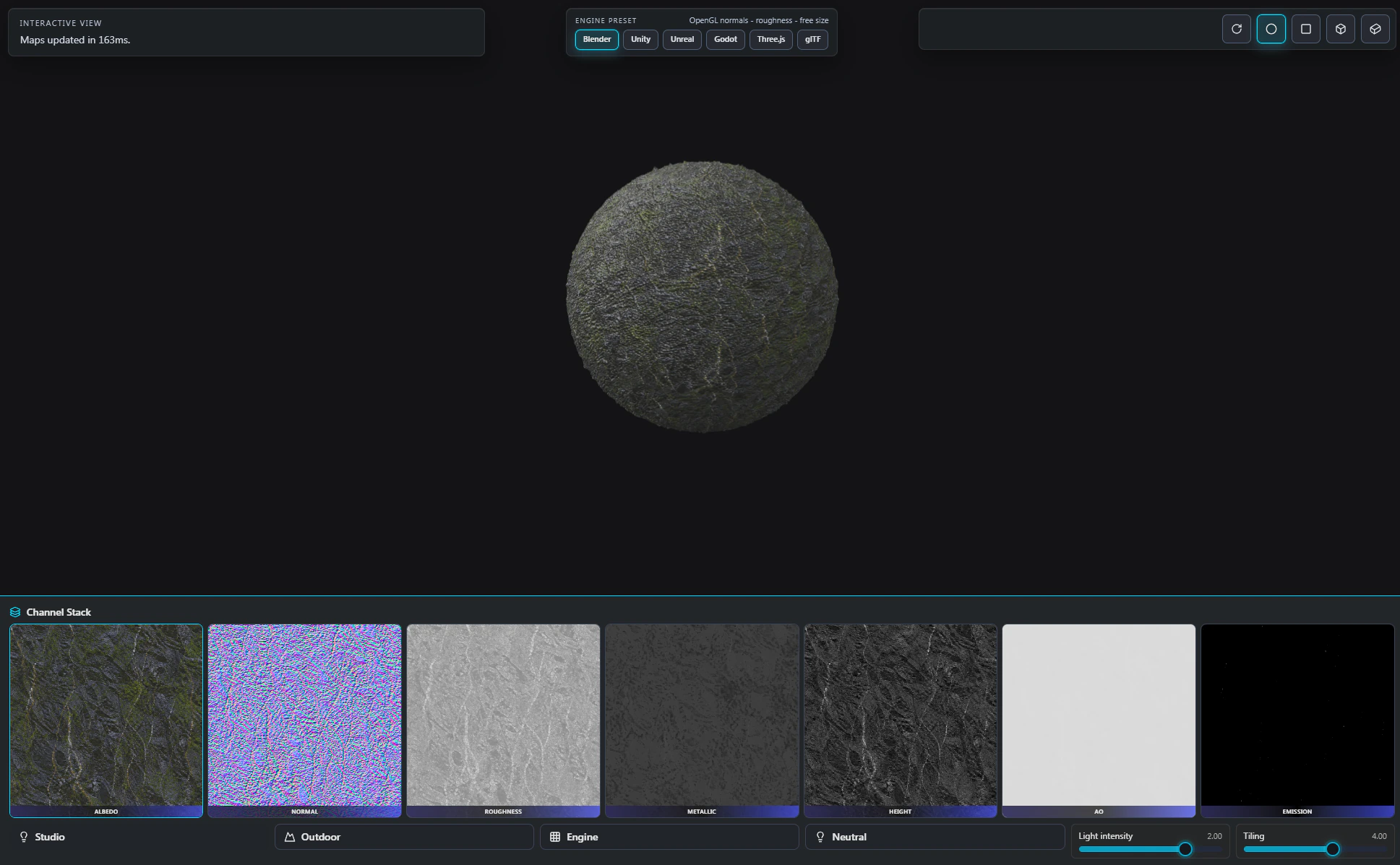
- The current workspace exposes seven output roles: albedo, normal, roughness, metallic, height, ambient occlusion, and emission.
- Blender, Godot, Three.js, and glTF presets use OpenGL normals with roughness output.
- The Unity preset uses OpenGL normals with smoothness output.
- The Unreal preset uses DirectX normals with roughness output.
- The glTF package writes roughness to G and metallic to B; its occlusion texture remains a separate R-channel input.
Limit: This is a repository and UI contract snapshot, not a claim that every external engine project uses the same shader, packing, compression, or import defaults.
All 34 terms with aliases, definitions, anti-definitions, contracts, deep links, and source IDs.
Machine-readable JSONVersioned glossary data plus source metadata and the documented PLAYTEX AI evidence snapshot.
Cited source listPrimary documentation, version labels, review date, and the exact claims each source supports.
Primary documentation
Versioned sources
- Khronos glTF 2.0 Specification — glTF 2.0. Metallic-roughness material semantics, transfer functions, tangent-space normals, occlusion, emission, and channel layouts.
- Unity 6.1 Manual: Introduction to normal maps — Unity 6.1 (6000.1). Normal maps, bump and height distinctions, Y+ convention, tangent-space vector encoding, and flat-normal value.
- Unity 6 API: TextureImporter.sRGBTexture — Unity 6 (6000.0 documentation build). sRGB sampling for color textures and linear sampling for non-color data textures.
- Unreal Engine 5.8: Physically Based Materials — Unreal Engine 5.8. Base Color, Roughness, Metallic, Specular, normalized ranges, and binary metal classification guidance.
- Unreal Engine 5.8: Using Texture Masks — Unreal Engine 5.8. Mask semantics, RGB channel packing, linear sampling, and the distinction between packed source data and runtime use.
- Godot stable: StandardMaterial3D and ORMMaterial3D — Godot stable documentation checked August 2026. OpenGL-style normal orientation, green-channel conversion, and standard material inputs.
- Blender Manual: Principled BSDF — Blender latest manual checked August 2026. Principled material inputs including base color, metallic, roughness, emission, alpha, and normal.
- Three.js: MeshStandardMaterial — Three.js current documentation checked August 2026. Metallic-roughness material inputs and renderer-facing texture roles.
- Khronos KTX 2.0 Specification — KTX 2.0. Texture containers, mip levels, supercompression, and GPU-oriented texture delivery.