Why Deterministic PBR Map Generation Outperforms AI for Production-Ready Game Assets
While AI offers speed for initial texture concepts, relying solely on it for PBR map generation can introduce critical inconsistencies and inaccuracies for production-ready game assets. Discover why deterministic methods are essential for precision.
Reviewed June 5, 2026
June 5, 2026pbr mappingai texturesgame developmenttexture generation
Key Takeaways
Deterministic PBR map generation provides the precision, control, and consistency essential for production-ready game assets.
AI texture generation is effective for concepting, generating base textures, and rapid prototyping, but often lacks the physical accuracy for PBR maps.
AI-generated PBR maps may introduce inconsistencies, artifacts, and fail to adhere to PBR principles, requiring significant manual correction.
PLAYTEX offers a hybrid workflow, combining AI texture generation for speed with a deterministic PBR Map Generator for accurate, engine-ready outputs.
Understanding core PBR principles and clear commercial use policies are vital for successful game asset pipelines.
Who Informed This
This article is informed by an understanding of modern game development workflows, PBR material standards, and the capabilities of both AI-driven and deterministic texture generation tools. It reflects the practical needs of game developers for precision and consistency in asset creation.
How It Was Evaluated
The claims are based on a comparative analysis of AI's current capabilities in texture generation versus the established requirements for physically accurate, production-ready PBR maps in game engines, referencing industry standards and PLAYTEX's product features.
Proof And Evidence
PLAYTEX directly addresses the outlined challenges by offering both an AI Texture Generator for initial creative work and a dedicated, deterministic PBR Map Generator designed for precision and consistency, ensuring outputs are production-ready and adhere to PBR principles. Its commercial use policy provides clear ownership guidelines.
Limits And Caveats
This article focuses on the specific challenges of AI for *PBR map generation* for production assets, not on AI's overall utility in game development. It does not delve into the technical specifics of various AI models or a comprehensive comparison of all AI texture tools on the market.
The landscape of game development is rapidly evolving, with artificial intelligence (AI) emerging as a powerful tool for accelerating various creative processes. From generating concept art to automating repetitive tasks, AI promises unprecedented speed and iteration. When it comes to texturing, AI texture generation can quickly produce base textures and kickstart visual development. However, for the critical task of generating Physically Based Rendering (PBR) maps, relying solely on AI presents unique challenges that can impact the quality and consistency of your final game assets.
This article will explore why, despite AI's undeniable benefits in certain texturing phases, deterministic PBR map generation remains the superior choice for achieving the precision, control, and consistency required for production-ready materials. We'll also highlight how a platform like PLAYTEX integrates both AI and deterministic methods to provide a robust solution for modern game development pipelines.
What is PBR Mapping and Why is Precision Critical?
Physically Based Rendering (PBR) is a shading and rendering technique that aims to represent how light interacts with surfaces in a physically accurate way. Unlike older rendering methods, PBR relies on a set of interconnected texture maps—such as Albedo (Base Color), Normal, Roughness, Metallic, Ambient Occlusion, and Height—to define a material's properties. These maps must adhere to real-world physics principles, including energy conservation, to ensure consistent and believable lighting across different environments and engines.
For game developers, precision in PBR mapping is not just about aesthetics; it's about technical integrity. Inaccurate maps can lead to visual artifacts, inconsistent material responses, and a breakdown of realism. Industry standards, such as those outlined by Khronos for glTF assets, emphasize the importance of correctly authored PBR materials for interoperability and consistent rendering across various platforms. Achieving this level of accuracy demands control and predictability in the map generation process.
The Promise of AI for PBR Mapping: Speed and Iteration
AI texture generation tools have revolutionized the initial stages of asset creation. They offer several compelling advantages:
AI excels at generating a wide range of texture variations quickly, ideal for concepting and rapid iteration in the early stages of game development.
Rapid Concepting: Artists can quickly generate a wide array of texture variations from simple prompts or reference images, accelerating the concept phase.
Base Texture Creation: AI can provide a solid foundation for textures, saving time on manual painting or photo manipulation for initial diffuse or albedo maps.
Quick Iteration: Experimenting with different material looks becomes faster, allowing artists to explore more options in less time.
For generating a starting point or exploring creative directions, AI is an invaluable asset. It can break through creative blocks and provide a diverse range of visual ideas with minimal effort.
The Inherent Challenges of AI for Accurate PBR Map Generation
While AI shines in generating creative textures, its application to the precise, interconnected world of PBR map generation introduces significant hurdles for production-ready assets.
AI-generated PBR maps can often lack the deterministic consistency and physical accuracy needed, leading to artifacts and requiring significant manual refinement.
Lack of Deterministic Control and Consistency
One of the primary drawbacks of many general-purpose AI texture generators is their non-deterministic nature. When generating a full set of PBR maps (Albedo, Normal, Roughness, Metallic, etc.), consistency across these maps is paramount. An AI might generate an excellent Albedo map, but its corresponding Normal or Roughness maps might not accurately reflect the physical properties implied by the Albedo. This leads to:
Inconsistent Material Properties: A material might appear metallic in one map but diffuse in another, breaking physical accuracy.
Unpredictable Outputs: Small changes in prompts or input images can lead to drastically different map sets, making it difficult to achieve repeatable results.
Manual Correction Overhead: Artists often spend significant time manually correcting or re-generating maps to ensure they align, negating the initial time-saving benefits.
Difficulty in Consistently Adhering to Physical Accuracy
PBR relies on strict physical principles like energy conservation (light reflected + light absorbed = 1). AI models, especially those trained on diverse datasets without explicit PBR constraints, can struggle to consistently adhere to these rules. This can result in:
Non-Physically Accurate Materials: Surfaces that look 'off' or don't react realistically to light.
Incorrect Metallic/Roughness Values: Materials might appear too shiny, too dull, or exhibit incorrect reflectivity for their type.
Artifacts and Imperfections: AI can introduce subtle artifacts, tiling issues, or unnatural patterns that are difficult to spot until integrated into an engine, requiring costly rework.
"Deterministic PBR map generation provides the precision, control, and consistency essential for production-ready game assets."
Intellectual Property and Commercial Use Concerns
The legal landscape around AI-generated content, especially concerning intellectual property (IP) and commercial use, is still evolving. When using general AI tools, questions often arise about who owns the generated output and whether it's safe for commercial projects. This uncertainty can pose significant risks for studios and indie developers alike.
Platforms like PLAYTEX address this directly by providing clear guidelines on commercial use and output ownership. This transparency is crucial for teams needing to ship assets without legal ambiguity.
When AI *Is* Beneficial in the Texturing Workflow
It's important to reiterate that AI has a valuable place in the texturing pipeline. It excels where creative exploration and speed are prioritized over pixel-perfect physical accuracy:
Initial Texture Generation: Creating base textures from text prompts or reference images.
Concept Art and Mood Boards: Rapidly generating visual ideas for environments or props.
Rapid Prototyping: Quickly applying placeholder textures to models for early-stage testing.
Texture Variations: Generating multiple stylistic options for a single asset.
For these applications, AI provides an unmatched boost to productivity and creativity. The key is understanding its strengths and integrating it strategically into a broader, more robust workflow.
The PLAYTEX Approach: Combining AI Texture Generation with Deterministic PBR Map Generation
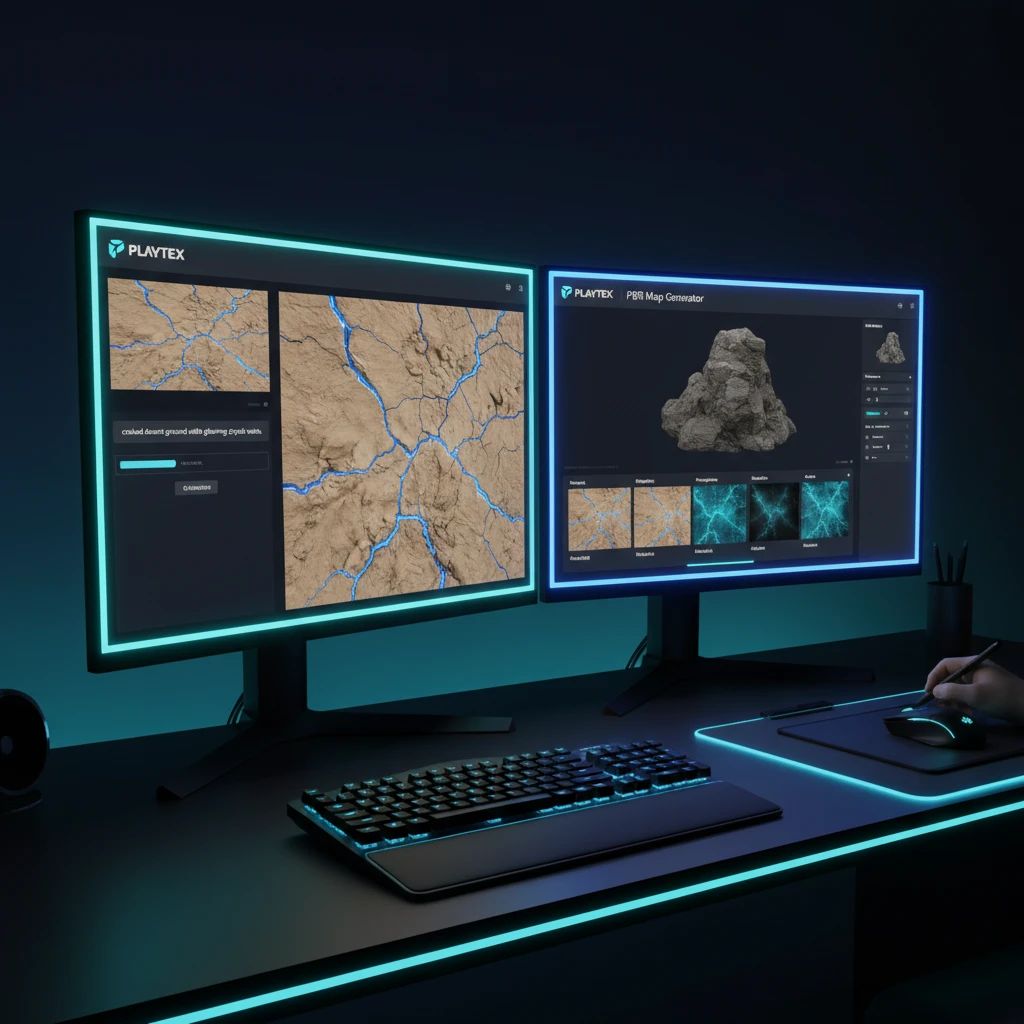
Recognizing the distinct strengths and weaknesses of AI, PLAYTEX offers a comprehensive solution that empowers game developers to leverage the best of both worlds. Our platform integrates both AI-powered texture generation and a dedicated, deterministic PBR Map Generator.
PLAYTEX combines the creative speed of AI texture generation with the precision of deterministic PBR map generation for a complete, production-ready workflow.
With PLAYTEX, you can:
Start with AI for Base Textures: Use our AI Texture Generator to quickly create initial textures from concepts or images, providing a creative springboard.
Generate Production-Ready PBR Maps: Transition to the PLAYTEX PBR Map Generator for precise, physically accurate, and consistent PBR map sets. This deterministic approach ensures that your Normal, Roughness, Metallic, and other maps are perfectly calibrated and adhere to PBR principles, ready for engine integration. Our technical overview details this process.
Ensure Commercial Readiness: Benefit from clear commercial use policies, giving you confidence in using your generated assets in shipped titles.
Maintain Control: Artists retain full control over the final output, ensuring that the artistic vision is met with technical accuracy.
This hybrid workflow allows artists to harness AI for speed and ideation without compromising on the critical precision and consistency required for high-quality, production-ready PBR materials.
Conclusion
While AI is transforming many aspects of game development, its role in PBR map generation requires a nuanced understanding. For initial texture concepts and rapid prototyping, AI is an incredibly powerful tool. However, for generating the precise, physically accurate, and consistent PBR maps essential for production-ready game assets, deterministic methods offer unmatched reliability and control.
PLAYTEX provides a workflow that intelligently combines the creative power of AI texture generation with the technical rigor of deterministic PBR map generation. This ensures that game developers and artists can achieve both speed in ideation and unwavering quality in their final materials, confidently bringing their visions to life.