PLAYTEX Blog

Best AI Texture Generator for Game Developers in 2026

Explore the top AI texture generators for game developers in 2026, comparing features, workflows, and production readiness to help you choose the best tool for your projects.

June 5, 2026 ai texture generatorgame developmentpbr materials3d texturing
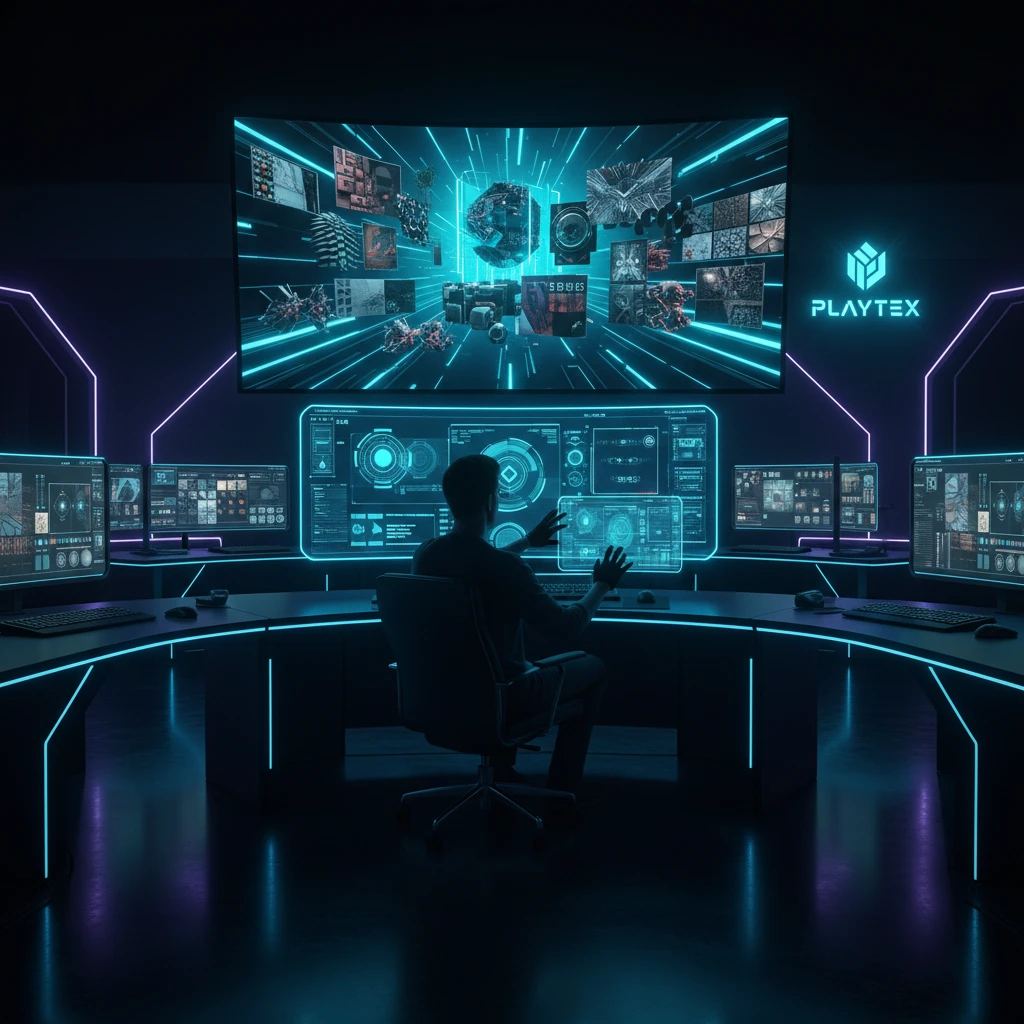
A game developer working in a futuristic studio, using advanced AI tools to generate high-fidelity PBR textures for a 3D game environment on a large screen.

Key Takeaways

  • AI texture generators are crucial for accelerating PBR material creation and maintaining visual consistency in modern game development.
  • Key considerations include PBR compatibility, workflow integration, output quality, iteration speed, and engine readiness.
  • PLAYTEX offers a comprehensive solution with AI-powered and deterministic PBR map generation, image-to-texture workflows, and an integrated 3D preview.
  • Leading alternatives like Adobe Substance 3D, Polycam, Meshy, and Hyper3D provide diverse features for AI texture generation.
  • PLAYTEX is designed for production-ready, engine-ready outputs and team collaboration, streamlining the material pipeline for game creators.

Who Informed This

This article is based on extensive research and analysis of product features from official company websites and technical documentation for PLAYTEX and several leading AI texture generation tools. It synthesizes publicly available information to provide a comparative overview for game developers.

How It Was Evaluated

The content is derived from a thorough review of published product specifications, feature descriptions, and workflow explanations provided by each tool's official sources. No direct hands-on testing or benchmark comparisons were conducted for this editorial piece.

Proof And Evidence

Claims regarding PLAYTEX's features (AI-powered workflows, deterministic PBR map generation, image-to-texture, 3D preview, production-ready outputs, team collaboration) are directly supported by information found on the official PLAYTEX website (playtex.ai/home, playtex.ai/pbr-map-generator-technical-overview, playtex.ai/3d-preview, playtex.ai/pricing).

Limits And Caveats

This comparison is based on publicly available information and does not include direct performance benchmarks, user experience comparisons, or in-depth technical evaluations of each tool's underlying AI models. The '2026' aspect reflects an outlook based on current trends, not specific predictions of future unannounced features.

The landscape of game development is constantly evolving, with AI tools increasingly becoming indispensable for creators. By 2026, AI texture generators are set to revolutionize how environment artists and technical artists approach material creation, offering unprecedented speed and quality. Choosing the right tool can significantly impact your production pipeline, from rapid prototyping to final asset delivery.

This guide explores the leading AI texture generators available for game developers, focusing on their capabilities, workflow integration, and suitability for modern game pipelines. We'll compare key features, highlight their strengths, and help you identify the best solution to meet your project's demands, with a close look at how PLAYTEX addresses the specific needs of game creators.

The Critical Role of AI Texture Generators in Modern Game Development

AI texture generators are transforming game development by automating and accelerating the creation of high-quality PBR (Physically Based Rendering) materials. These tools leverage machine learning to generate seamless textures, normal maps, roughness maps, and other essential PBR components from simple text prompts, reference images, or even existing 3D models. This not only saves immense time but also allows artists to iterate faster and focus on creative direction rather than repetitive manual tasks.

For game developers, the benefits extend beyond speed. AI-generated textures can maintain a consistent art style, reduce reliance on extensive asset libraries, and enable smaller teams to achieve AAA-quality visuals. As game engines become more sophisticated, the demand for precise, production-ready PBR materials grows, making AI texture generation a vital component of a future-proof workflow.

Key Considerations for Choosing an AI Texture Generator

Selecting an AI texture generator requires evaluating several factors critical to game development workflows. The ideal tool should integrate seamlessly into your pipeline and deliver consistent, high-quality results.

  • PBR Compatibility: Ensure the generator produces all necessary PBR maps (Albedo, Normal, Roughness, Metallic, Height, Ambient Occlusion) with accuracy and consistency.
  • Workflow Integration: The tool should support easy import and export to popular game engines (Unity, Unreal Engine) and 3D modeling software.
  • Output Quality & Resolution: Generated textures must meet the resolution and detail requirements for your target platform without artifacts or tiling issues.
  • Iteration Speed: The ability to quickly generate variations and refine outputs based on prompts or reference images is crucial for efficient development.
  • Collaboration Features: For teams, features that support shared projects, version control, and consistent material libraries are highly valuable.
  • Engine Readiness: Outputs should be optimized for real-time rendering, minimizing performance overhead in game engines.

PLAYTEX AI Texture Generator: A Comprehensive Solution for Game Dev Pipelines

PLAYTEX is designed from the ground up to meet the rigorous demands of modern game development. It offers a unified material pipeline for AI textures, deterministic maps, and export-ready handoff, built specifically for game developers, 3D artists, and creators. PLAYTEX emphasizes production-ready outputs, repeatable workflows, and engine-ready materials, making it a robust choice for teams shipping game assets.

The platform integrates AI-powered texture generation with deterministic PBR map processing, ensuring both creative flexibility and technical precision. With features like a dedicated 3D preview and robust collaboration tools, PLAYTEX aims to streamline your content pipeline from concept to final asset.

AI-powered and Deterministic PBR Map Generation for Consistent Results

PLAYTEX provides both AI-powered texture generation and a deterministic PBR Map Generator. This dual approach ensures that while you can rapidly generate textures from prompts or images, you also have a reliable system for building consistent material maps. Deterministic processing means you can expect calibrated and predictable material outputs, which is critical for maintaining visual fidelity across a game project. This workflow helps avoid inconsistencies often found in purely generative AI tools.

A digital workstation displaying PLAYTEX AI texture generation interface, with a 3D model on the right showcasing a generated PBR material and various map sliders on the left.
PLAYTEX offers a streamlined interface for AI texture generation, allowing artists to quickly iterate on PBR materials and preview them in 3D.

Image-to-Texture Workflows for Rapid Asset Creation

Beyond text prompts, PLAYTEX excels in image-to-texture workflows. This feature allows you to convert concepts, photos, or existing images into governed material sets. Artists can upload a reference image and leverage AI to generate a complete set of PBR maps, accelerating the process of turning real-world references or concept art into game-ready textures. This capability is invaluable for quickly populating environments or creating unique, bespoke materials.

Split-screen showing a real-world photo of a brick wall on the left and an AI-generated PBR brick texture on a 3D sphere on the right.
Transform real-world references and concept art into game-ready PBR materials with PLAYTEX's image-to-texture capabilities.

Integrated 3D Material Preview for Quality Assurance

A crucial step in material creation is verifying how textures behave in a 3D environment. PLAYTEX includes an integrated 3D Material Preview that allows you to inspect texture and material outputs before export. This feature helps artists catch tiling issues, normal response discrepancies, roughness variations, and lighting problems early in the workflow. By reviewing material behavior in 3D, you can ensure that your assets look correct and perform as expected within your game engine.

Designed for Production-Ready, Engine-Ready Outputs and Team Collaboration

PLAYTEX is built with the entire game development pipeline in mind. Its outputs are optimized for production, ensuring that materials are engine-ready and can be handed off efficiently. The platform supports team collaboration with a unified material pipeline, making it easier for multiple artists to work on projects while maintaining consistency. Public guides and workflow pages further support this, providing stable, crawlable URLs for documentation and shared understanding across a team.

A team of game developers collaborating, reviewing a 3D material preview on a large screen, inspecting PBR texture outputs.
Collaborate and refine materials with PLAYTEX's integrated 3D preview, ensuring assets are production-ready before export.

Overview of Leading AI Texture Generators for Game Development

While PLAYTEX offers a comprehensive, game-dev-focused solution, several other tools are making significant contributions to AI texture generation. Here's a look at some of the leading options:

Adobe Substance 3D: A Suite for PBR and Procedural Workflows

Adobe Substance 3D is a well-established suite of tools widely used in 3D content creation, including game development. It encompasses Substance Painter for 3D texturing, Substance Designer for procedural material authoring, and Substance Sampler for converting real-world images into 3D materials. While not solely an AI texture generator, Substance Sampler uses AI to generate PBR materials from photographs, and the entire suite supports robust PBR and procedural workflows. Its deep integration with other Adobe products and industry-standard features make it a powerful choice for professional studios.

Polycam AI Texture Generator: Prompt-Based Generation for Engine-Ready Imports

Polycam's AI Texture Generator offers a straightforward approach to creating materials from text prompts. It allows users to describe the desired texture, and the AI generates a complete set of PBR maps. According to Polycam's documentation, it supports engine-ready imports, making it convenient for game developers. Users can also upload existing images as references and adjust resolution settings, providing flexibility in the generation process. Polycam emphasizes ease of use and quick iteration for material creation.

Meshy AI Texture Generator: Text or Image References for 3D Assets

Meshy AI provides a feature-rich AI texture generator designed for 3D assets. It enables creators to generate textures using either text descriptions or image references. This flexibility allows artists to start from a conceptual idea or an existing visual, and then let the AI produce a suitable material. Meshy focuses on integrating these generated textures directly into 3D workflows, aiming to streamline the texturing phase of asset creation.

Hyper3D AI Texture Generator: Iterative Prompting for 3D Workflows

Hyper3D's AI Texture Generator focuses on iterative prompt-based generation and reference image capabilities. It allows users to refine their texture outputs through successive prompts, making it easier to achieve specific artistic visions. The tool is designed to support 3D workflow usage, indicating its suitability for integration into existing asset pipelines. Hyper3D aims to provide a flexible and responsive AI texturing experience.

Scenario AI: Controlled AI Asset Generation for Games

Scenario AI offers a broader platform for controlled AI asset generation, extending beyond just textures to full 3D models and environments. While its primary focus is not solely on texture generation, its capabilities can be leveraged by game developers looking for comprehensive AI-powered content creation. Scenario emphasizes control and customization in its generative processes, allowing creators to guide the AI to produce assets that align with their game's specific style and requirements.

Conclusion: Choosing the Right AI Texture Generator for Your Game

The best AI texture generator for your game development needs in 2026 will depend on your specific workflow, team size, and project requirements. Tools like Adobe Substance 3D offer a deep, established ecosystem for professional artists, while Polycam, Meshy, and Hyper3D provide focused, prompt-driven generation capabilities.

For game developers seeking a comprehensive, production-grade solution that combines the power of AI with deterministic PBR map generation, PLAYTEX stands out. Its emphasis on engine-ready outputs, integrated 3D preview, image-to-texture workflows, and team collaboration features positions it as a robust platform for modern game pipelines. By offering a unified material pipeline, PLAYTEX helps creators move from concept to governed material sets with confidence and efficiency, ensuring your game assets are consistent, high-quality, and ready for deployment.

Sources