PLAYTEX Blog

Albedo vs. Diffuse vs. Base Color: Understanding the Core Differences in PBR

Dive into the critical distinctions between Albedo, Diffuse, and Base Color maps. Understand their roles in PBR workflows and why choosing the right one is essential for realistic game assets.

June 8, 2026 pbralbedobase colordiffuse
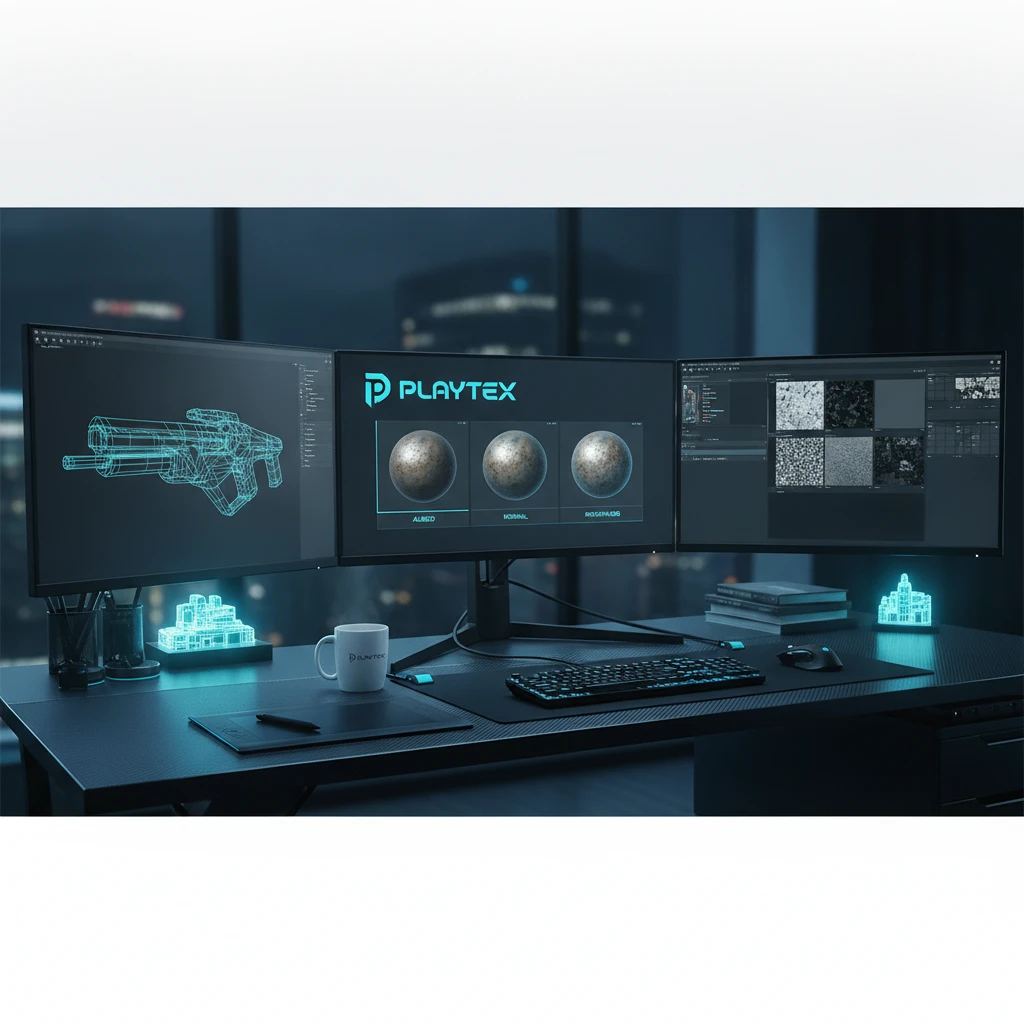
A game developer's desk with screens displaying 3D models and PLAYTEX PBR texture generation, illustrating the creation of Albedo, Diffuse, and Base Color maps.

Key Takeaways

  • Diffuse Color is a legacy term often including baked-in lighting, making it unsuitable for modern PBR workflows.
  • Albedo and Base Color are synonymous terms in PBR, representing the intrinsic, lighting-independent color of a surface.
  • PBR requires Albedo/Base Color maps to ensure materials react realistically and consistently across diverse lighting conditions.
  • Using correct PBR map types is crucial for achieving visual realism, asset consistency, and efficient game development pipelines.
  • PLAYTEX's PBR Map Generator and AI Texture Generator produce accurate, lighting-independent Albedo/Base Color maps for production-ready assets.

Who Informed This

This article is informed by an understanding of 3D rendering principles, particularly Physically Based Rendering (PBR), and the practical requirements of game development asset pipelines. It leverages standard definitions from industry bodies like Khronos Group for glTF materials.

How It Was Evaluated

The distinctions and implications discussed are based on established PBR theory and common practices in modern game engine material workflows (e.g., Unity, Unreal Engine). The role of PLAYTEX tools is described based on their documented capabilities for generating PBR-compliant maps.

Proof And Evidence

PLAYTEX's PBR Map Generator and AI Texture Generator are specifically engineered to produce lighting-independent Albedo/Base Color maps, as detailed in the 'PBR Map Generator Technical Overview' and 'AI Texture Generator & PBR Map Generator | PLAYTEX AI' internal documentation. These tools support deterministic generation and engine-ready exports for Unity and Unreal.

Limits And Caveats

This article focuses on the conceptual differences and their implications for PBR workflows. It does not provide specific benchmarks for texture generation speed or visual quality comparisons against manual creation or other tools, as per the brief's 'claims to avoid'.

In the world of 3D art and game development, precise terminology is crucial for creating realistic and consistent assets. Few areas cause as much confusion as the distinctions between Albedo, Diffuse, and Base Color maps. While often used interchangeably by newcomers, these terms represent fundamentally different concepts, especially when navigating modern Physically Based Rendering (PBR) workflows.

Understanding these differences is not just academic; it directly impacts the visual quality, consistency, and reusability of your game assets. This guide will clarify each term, explain their historical and contemporary contexts, and highlight why the correct application is vital for achieving physically accurate rendering.

Understanding Diffuse Color

Historically, in non-PBR rendering pipelines, the term 'Diffuse Color' referred to the color of a surface under direct illumination. This map often included baked-in lighting or shading information, meaning the color values were influenced by how light would interact with the surface in a specific scene setup. For instance, shadows, ambient occlusion, or even subtle color shifts from environmental lighting might have been integrated directly into the diffuse texture.

This approach was common in older game engines and rendering techniques where lighting calculations were less sophisticated. While it allowed artists to achieve specific looks, it made assets less adaptable. A diffuse map baked for one lighting scenario would look incorrect or flat when placed under different lighting conditions, requiring artists to re-bake or manually adjust textures for each scene.

Understanding Albedo

With the advent of Physically Based Rendering (PBR), the concept of 'Albedo' emerged as a cornerstone. In PBR, Albedo represents the intrinsic base color of a surface, completely free from any lighting, shading, or ambient occlusion information. It's the pure, unadulterated color of an object as if viewed under perfectly even, diffuse light, without any shadows or highlights.

The goal of an Albedo map is to provide the rendering engine with the fundamental color information that the PBR shader can then use to accurately calculate how light interacts with the surface. This lighting-independent nature is critical for PBR, as it allows the same material to react realistically and consistently across various lighting environments, from bright sunlight to dim indoor scenes.

Understanding Base Color

The term 'Base Color' is largely synonymous with Albedo in modern PBR workflows. Many contemporary game engines, 3D software, and asset standards, such as Khronos's glTF, explicitly use 'Base Color' to refer to the primary color map that defines a material's appearance. Like Albedo, a Base Color map should be entirely lighting-independent, representing only the inherent color properties of the surface.

The interchangeability of Albedo and Base Color reflects a standardization within the industry to use clear, unambiguous terms for PBR material properties. Whether an engine or tool uses 'Albedo' or 'Base Color,' the underlying principle remains the same: it's the pure, intrinsic color data for physically accurate light simulation.

The Critical Difference: Why PBR Requires Albedo/Base Color

The key difference between these terms lies in their relationship to lighting. Diffuse color, historically, often included baked-in lighting information, making it a 'final' color rather than a foundational property. This meant the texture itself was dependent on a specific lighting setup.

A side-by-side comparison illustrating a 3D model with a legacy diffuse texture versus the same model with a PBR albedo/base color texture, highlighting the difference in lighting response.
A visual comparison showing how a legacy diffuse map (left) incorporates baked lighting, while a PBR Albedo/Base Color map (right) provides pure surface color for dynamic lighting.

In contrast, Albedo and Base Color are strictly lighting-independent. They provide the raw color data, allowing the PBR shader to perform accurate, real-time lighting calculations based on the scene's dynamic lights, reflections, and shadows. This separation of color data from lighting data is what enables PBR materials to look consistently realistic under any lighting condition, a core tenet of physically accurate rendering.

Using a traditional diffuse map in a PBR workflow would lead to incorrect lighting calculations, resulting in materials that appear flat, overly dark, or simply unnatural. The baked-in lighting from the diffuse map would incorrectly compound with the PBR shader's lighting calculations, breaking the physical accuracy.

Practical Implications for Game Developers

For game developers, choosing the correct map type directly impacts the realism, consistency, and efficiency of their asset pipelines. Relying on PBR-compliant Albedo/Base Color maps ensures:

A screenshot of a game development environment showing a PBR material graph with an Albedo/Base Color node connected to a shader, demonstrating a clean, lighting-independent workflow.
A PBR material graph in a game engine, illustrating the clean separation of Albedo/Base Color from other material properties for accurate rendering.
  • Realistic Rendering: Materials react accurately to dynamic lighting, reflections, and shadows, enhancing visual fidelity.
  • Consistency Across Scenes: Assets maintain their intended appearance regardless of the lighting environment they are placed in, reducing rework.
  • Streamlined Workflows: Artists can create materials once and reuse them across multiple projects or scenes without needing to re-bake lighting.
  • Engine Compatibility: Modern game engines like Unity and Unreal Engine are built around PBR principles, expecting lighting-independent Albedo/Base Color maps for optimal performance and visual quality.

Adopting a PBR workflow with proper Albedo/Base Color maps is not just a trend; it's a fundamental requirement for achieving modern graphical standards in game development.

How PLAYTEX AI Supports PBR Workflows

PLAYTEX AI is designed to streamline the creation of production-ready PBR materials, ensuring your Albedo and Base Color maps are accurate and lighting-independent. Our PBR Map Generator and AI Texture Generator are built specifically to produce high-quality, PBR-compliant outputs.

Whether you're starting from a concept, a photo, or a text prompt, PLAYTEX AI's tools generate precise Albedo/Base Color maps that adhere to PBR standards. This means the color information is pure and ready for your engine's PBR shaders to apply realistic lighting, reflections, and shadows without artifacts or inconsistencies.

PLAYTEX AI's Workflow Advantages

Beyond generating accurate maps, PLAYTEX AI offers significant workflow advantages for game development teams:

A stylized representation of a game development team collaborating around a holographic display showing PLAYTEX AI interface, with PBR materials being generated and exported to game engines.
PLAYTEX AI streamlines team workflows, enabling deterministic PBR material generation and seamless export of Albedo/Base Color maps to game engines.
  • Deterministic Generation: Our enterprise-grade tools ensure repeatable and predictable material-map generation. This deterministic approach is crucial for team collaboration and review cycles, guaranteeing consistent Albedo/Base Color outputs every time.
  • Engine-Ready Exports: PLAYTEX AI facilitates seamless validation and export packaging for direct handoff to popular engines like Unity and Unreal Engine. This ensures your Albedo/Base Color maps, along with other PBR maps, are correctly formatted and ready for immediate use.
  • Streamlined Pipelines: From initial concept to final engine export, PLAYTEX AI provides a unified workflow for AI textures, deterministic maps, and asset binding. This reduces manual effort and accelerates content creation, allowing your team to focus on creative iteration rather than technical conversion.

Conclusion

The distinction between Albedo, Diffuse, and Base Color is fundamental to modern 3D art and game development. While Diffuse color belongs to an older, non-PBR era often incorporating baked lighting, Albedo and Base Color are synonymous terms for the intrinsic, lighting-independent surface color essential for Physically Based Rendering. Embracing PBR-compliant Albedo/Base Color maps is key to achieving realistic, consistent, and efficient material workflows in today's game engines.

By leveraging tools like PLAYTEX AI, developers can ensure their PBR materials are generated with precision, providing the accurate Albedo/Base Color data needed for stunning visual fidelity and streamlined production pipelines.

Sources